Rain periodically lashed the red carpet outside the Empire Leicester Square for Tuesday’s “premiere” of Chariots of Fire, if you can meaningfully call the showing of a 31-year-old film with barely even a fresh lick of paint a “premiere”.
Thus the crowd that assembled, hoping for a glimpse of stars Ben Cross and Nigel Havers, was meagre, but dogged. Cross and Havers gamely stood outside, taking in interviews and scratching out autographs, under flunky-held parasols. A healthy representation of Olympians past and present lent currency to what was, really, an opportunistic, commercial affair: the hope of fresh milk from an old cow.
The Sun Cheerleaders were there too, gormlessly woo-hooing around the carpet. Few (other than Havers and Cross) lingered outside longer than their contracts obliged.
The Empire’s theatre is colossal. It felt as if it could enclose Paris’ 1924 Olympic Stadium in whole. Flickfeast sat at the back. A javelin-throw away, on stage, director Hugh Hudson and his principal cast introduced the film. Hudson made brief remarks and scattered before him manifold profound acknowledgments, as theatrical convention requires. Touchingly, he remembered those no longer with us, amongst them Sir John Gielgud and, tragically, Ian Charleson, who succumbed to AIDS twenty years ago, at about the age his character, Eric Liddell, died in Occupied China.
The biggest cheer of the night was saved, correctly, for the portly, bearded Greek gentleman whose contribution, perhaps single-handedly, vouchsafed Chariots of Fire its immortality. Vangelis Papathanassiou (just mention of his Christian name sets off a thousand Chariots of Fire earwigs: mine is still going 48 hours later) rose coyly to a well-deserved standing ovation.
Hudson promised that 1981 film has not been altered in any way for this release: just cleaned up, enhanced and digitised. Maybe the celluloid was in bad shape, for the “enhancements” were not remarkable. The ambient soundtrack and dialogue remains something less than THX certified 7.1 surround sound, though Vangelis’ ethereal score sounded better than ever.
Chariots of Fire is an old-fashioned melodrama rendered sublime by music. The music comes in three varieties, two of which are wildly anachronistic to its period: Vangelis’ square-waved futurism dominates (a style not unlike his subsequent work on Blade Runner) but there are frequent snatches of sacred choral music: Allegri’s Miserere, an a capella Magnificat and, and the end, Parry and Blake’s Jerusalem whence the film takes its name.
Afloat on this musical seascape, the film manages to portray the personal as aspirational – even ineffable – and heartily transcends its really rather cluttered screenplay.
Sometimes these small details don’t matter, but it is still true that Chariots of Fire is confused as to its protagonists and antagonists.
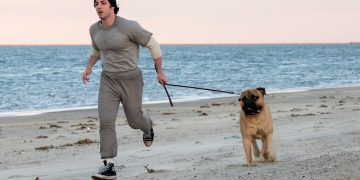
The early sequences are narrated through Aubrey Montague’s (Nicholas Farrell) letters home from training camp. It is Montague’s athletic form on which the screenplay opens, striding manfully down the beach at Broadstairs, leading the British cohort. But it is not his film. On his shoulder, mud-spattered and grinning like a labrador with its head out a car window, is Lord Lindsay (Havers). It isn’t his film either. Eventually Hudson shifts his fulcrum, and we settle on Harold Abrahams (Cross) and Liddell (Charleson) as the protagonists, and quietly wonder why Aubrey and Lindsay are in the picture at all.
Harold Abrahams (Ben Cross) is a bit of a conundrum too. One moment neurotic, driven relentlessly by perceived slights delivered soundlessly within the privileged circles through which he moves. The next a bon-vivant extrovert, thumping out G&S show tunes to the delight of those very same lords and ladies. Abrahams fancies himself as an outsider, but everywhere he is accepted plainly for who, and not what, he is.
The real outsider is Eric Liddell (Charleson). Outwardly a Boys’ Own hero: international rugby winger; champion sprinter – but at heart a stubborn, teetotal methodist evangelist. In early dispatches we see much of his divine countenance, in tweed, shining forth upon clouded (Scottish) hills. Later he tries to build Jerusalem among the satanic mills of The British Olympic Association by refusing to run on the Sabbath. The Olympic grandees want him to run for the glory of the King, religion be damned. Liddell will have none of it. It is left to Lindsay to construct a clever, face-saving solution; but it defuses what might have been powerful drama.
The collision of Abraham’s irresistible force with Liddell’s immovable object should surely be the central drama, but it too is largely fluffed: they do race in an early exchange – the desolate aftermath of which Vangelis memorably captures to the beat of folding grandstand seats – but by the final climax they are best chums, and in their stead a brace of under-explained Americans are shipped in as antagonists.
Those final, dramatic race scenes are filmed curiously, as if Hudson means to deflate rather than pump the tension. The celebrated slow-motion shots follow only after the whole race has been run without much fanfare. Nonetheless when they come, accompanied as they are by the Vangelis’ outstanding score – these sequences are mesmerising enough to support the film’s ambition.
I remember being swept away by Chariots of Fire in 1981: I was 11. I felt less like that in 2012, but the film retains plenty of emotional punch, and boasts so many iconic images, that it surely has a permanent place in the cinema history of this green and pleasant land.
Director: Hugh Hudson
Stars: Ben Cross, Ian Charleson, Nigel Havers, Nicholas Farrell, Ian Holm, John Gielgud, Alice Krige, Daniel Gerroll
Runtime: 124 minmin
Country: UK
Film Rating: