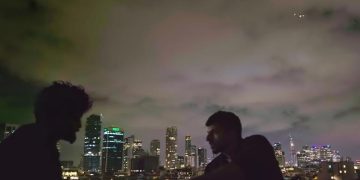
Anders Dalgaard’s documentary The Human Scale was chosen by this year’s Aldeburgh Documentary Festival to open Saturday’s programme. This visually stunning film rejects preconceived ideas about modernity and urbanism, and sets out to suggest that human beings and cities can co-exist in harmony. Featuring enchanting and breath-taking shots of cities from around the world, this film stuns as a sci-fi-esque representation of the present moment before it even presents its case.

Dalgaard uses the statistic that 50% of the world’s population currently lives in urban areas – a percentage which will have increased to 80% by 2050. Using the premises outlined by Danish architect Jan Gehl, Dalgaard proposes a re-construction of cities using the spaces we have already created to reduce pollution, the scale of automated transportation, and the culture of isolation which pervades urban society.
Several arguments that Dalgaard puts forward are incredibly appealing. The notion that human beings have rejected the notion of extended family and cohabitation in order to exist and function in cities certainly suggests its own veracity, and it also seems feasible to reverse this culture. Using Copenhagen, New York, and Melbourne as prime examples, Dalgaard suggests that by converting spaces designed for cars, machines, and dumpsters into spaces designed for humans, we can introduce a culture which accommodates for ‘the strong human need for inclusion and intimacy’, promoting interaction, and human movement.

The solutions and evidence that Jan Gehl and his team of architects put forward certainly suggests that it is possible to retain urbanism at the same time as promoting social cohabitation, by developing megacities into gigacities, with Gehl’s theory of ‘Life Between Buildings’ generating human-centric social spaces between the spaces of urban development.
The Documentary Festival’s discussion panel commend the film in many respects. Ricky Burdett, Professor of Urbanism, Roger Graef, filmmaker about cities and architecture, Sir Michael Hopkins, architect, and Marc Vlessing, founding director and CEO of Pocket, joined together after the screening to discuss the development of megacities and gigacities on an international level.

In many ways they confirm the concerns that Dalgaard and Gehl flag up. Where does private life end and public life begin? Do cities have to be messy in order to retain their character and function? In how many ways can pedestrianisation benefit a human society? Can you ever start completely afresh, or are all cities to some extent doomed by their own legacies?
The key point that Professor Ricky Burdett brought up was the notion of ‘doom’. Dalgaard’s film, despite being positive about the future of cities, is for the most part negative about the current function of cities. There are certain aspects to improve, but Ricky Burdett and Roger Graef point out that Dalgaard has ignored many of the positive aspects of urban space: the development of public transport in an attempt to lessen the gap between classes – both rich and poor can take a bus, the idea that cities with multiple centres have multiple cultures and purposes, and that in many ways suburban areas can outweigh the density of the high-rise.
The panel also add that those who commute for longer than 45 minutes per day are 40% more likely to get divorced from their partners. In some cities, commutes can take between 3 and 4 hours, but in Hong Kong the average commute takes 11 minutes. In many ways, The Human Scale suggests that we have walked into urban ruin with our eyes wide open, but Dalgaard, Gehl, and Aldeburgh DocFest’s discussion panel give concrete examples of how urban and social developments can take place simultaneously and that cities can continue to grow in size and population at the same time as strengthening human relationships and bonds.
Director: Andreas Dalsgaard
Writer: Andreas Dalsgaard
Stars: Jan Gehl, Rob Adams, He Dongquan
Runtime 83 min
Country: Denmark, Bangladesh, China, New Zealand, USA
Film Rating: