In this film pictures say a thousand words.
We open onto a nondescript German apartment block – it’s not Bauhaus, but it is a near thing. The shot tightens, drawing us into the repressing geometry and then closer still, into a plain door with a tiny peephole. We cut to a spinning, caged fan, and then a slowly rotating projector wheel.
Inside a dark room, two men are viewing movies of an unsavoury kind.
In a startling aerial shot, the mundane is rendered extraordinary: a square early ’80s model Audi reverses out of a tight row of parallel garages. Again, constrained by the geometry of the everyday: the car, the pavings, the garages.
All of this is casually symbolic of the immutable boundaries of lives, our ordinary constraints and the blinkered paths on which we must run. There is even a hamster in a cage. It doesn’t run on the wheel: it tries forlornly to escape, biting frantically at the wire. What is more, these establishing shots call to mind the familiar, shared dilemma: the private urge to overcome this linearity: the inevitability of all things. You might as well run, hamster: there’s no better alternative.
This is a film about individuals battling their private urges; trying vainly to escape the irrepressible geometry of their lives. It is a film about the stultifying human architecture which forbids it.
Of course, there are good and bad ways of self-overcoming. We realise we are observing two individuals who do unspeakable things. Their bond is not close. From above we watch them go about their business, in their square car, proceeding dully along a ramrod straight blacktop, populated either side by a verdant forest. They turn off the straight path to a deserted lane by a cornfield, in pursuit of a young girl on a bicycle.
The most uncomfortable scene, in a film full of them, comes in this opening sequence where we see the girl’s ghastly fate. One of the men is Timo, a mathematics student. He sits mutely in the car, only a witness to the murder. Quickly, he quits the town, horrified at the enormity of what he has seen, and his passive complicity in it. The perpetrator, Peer Sommer, pleads with him to stay, but even here the regular mechanisms of life – in this case a departing bus – contrive to frustrate him. Timo forges a new life. The men fall out of contact.
At the scene, all that remains is her discarded bicycle, some Walkman headphones and her bag. We learn her decomposed body is recovered some weeks later at the same lake.
We roll forward twenty three years. Timo has found a more constructive way of grappling with geometric and structural constraints that life presents: he is an architect. He has changed his name, married and has children.
Then, back in the original town, history repeats itself. A young girl goes missing, her cycle and bag are recovered at the identical spot. (There is much made of this possibly being a coincidence: surely, whatever it could be, it couldn’t be that). Timo’s simmering guilt, and his long-suppressed urges, pull him back into Peer’s world. Also drawn in are the police investigators, the disappeared girl’s parents, and also their correspondents from the original case: the murdered girl’s mother Elena, and the now retired detective on the original case, Krischan, who was unable to solve the murder.
The remainder of the film, with the odd flashback, charts the unravelling of this case, though to characterise this as a police procedural (or a thriller) would be to understate the engaging psychological and metaphorical study that Baran Bo Odar, in an assured debut, brings to the screen.
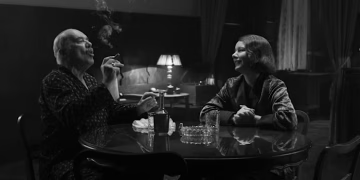
We track Elena as she jogs through the woods, on her own treadmill: a daily routine of visiting her daughter’s grave. She keeps her daughter’s bedroom as it was on the day of her disappearance: she too has had trouble overcoming. Her opportunity to break with the past comes in the unlikely form of Krischan, newly interested in the case following the disappearance, and in this way also striving to overcome. There is a more primal draw between the two: In a scene strikingly resemblent of Dracula, Krischan raps on Elena Lange’s shutters and scratches at her window, as if he were a vampire unable to pass without an invitation. Elena lets him in.
This latter exchange leads one of the few difficulties of the picture: characters occasionally act in incomprehensible ways, as if they are motivated by the requirements of Odar’s metaphorical scheme, and not their natural narrative arcs. Krischan and Elena’s interaction seems neither plausible nor really necessary: there is rather more relationship breakdown and inter-marital confusion than is strictly necessary to make the point.
Indeed, the cast of characters between them have as many afflictions as you could ask for: aside from the paedophiles there is a grieving, borderline unhinged police investigator, his pregnant police partner (who is left to enter the wolf’s lair single-handedly, Agent Starling style), dysfunctional but underdeveloped parents of the missing girl, and a bureaucratic, small-minded police chief who resents both the visionary weirdo chops of his star investigator and his offhanded treatment of Krischan, his predecessor.
The Silence’s thriller is tightly strung and astutely paced. Odar never allows the melodrama to dominate, and we are left with a stylish, sombre and rich film, which absolutely refuses to compromise its ending for the sake of neat resolution.
As the curtain falls, the picture is book-ended by the same oppressively symmetrical shot on which it opened, and it is clear that, in this story, there have been no winners or losers – the only winner is the inevitable machinery of modern life.
And the viewer of this thoughtful film.
The Silence is in cinemas 28th October 2011.
Director: Baran bo Odar
Stars: Ulrich Thomsen, Wotan Wilke Möhrin, Katrin Saß
Runtime: 120 min
Country: Germany
Film Rating: