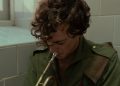
At 80, Eleanor Coppola became one of the oldest women to debut a feature as a director. Yet her filmography had mostly comprised behind-the-scenes documentaries involving the work of her husband and children, from Apocalypse Now to The Virgin Suicides. Her final film, Making Marie Antoinette, draws on 80 hours of footage and Eleanor’s journals, narrated by Diane Lane, to document the making of Sofia Coppola‘s third feature as a director.
To say that the production of Marie Antoinette is a family affair would be an understatement. While Sofia’s mother captures candid moments, Francis Ford Coppola watches his daughter navigate a demanding schedule. Meanwhile, their son Roman works as second-unit director, Sofia’s niece Gia Coppola has a supporting role, and her cousin Jason Schwartzman plays King Louis XVI. On the one hand, it comes across as a nepotistic project that demonstrates the influence—and legacy—of the Coppola family. There is a risk of creative differences among family members, yet Eleanor captures how those relationships develop into a creative collaboration to form an endearing and supportive working environment.
The majority of Making Marie Antoinette focuses on the visual splendour of its costume and production design. With a $40m budget and unprecedented access to the Palace of Versailles, it was Sofia Coppola’s biggest project at the time. There is particular attention paid to Milena Canonero’s costume design, which is as stunning as it is intricate. The insight into the film’s costumes, make-up and hair, not to mention the care and attention required to craft each piece, offers a quiet appreciation of the respective departments and their crews. This reiterates the documentary’s celebratory tone, which shines a light on the production’s unsung heroes.
Yet at the centre of the documentary is a woman seen through the eyes of her mother. Through her journal passages, Eleanor reiterates that Sofia is at the heart of both her film and Marie Antoinette, overseeing each scene and filmmaking decision within a predominantly male production team. Emotive moments, such as Sofia’s bout of bronchitis, convey Eleanor’s concern for her daughter’s well-being, while Sofia’s calmness behind the camera offers a quiet admiration for her vision as a filmmaker. There are also touches of humour in Eleanor’s inquisitive eye, naturally capturing the cast amid long shoots and repeated takes. Altogether, it doesn’t feel like a traditional behind-the-scenes documentary; it feels like a home video revisiting a period when mother and daughter were more than just family—they were collaborators.
Making Marie Antoinette is an unfiltered yet poignant celebration of filmmaking, family and a mother’s pride in her daughter’s unique creative vision.
Making Marie Antoinette is being shown as part of the BFI London Film Festival 2026.
Rating: 

Director: Eleanor Coppola
Stars: Sofia Coppola, Kirsten Dunst, Diane Lane
Runtime: 86 minutes
Country: USA, Italy