Graphic first love story
With the French title, La Vie d’Adèle – Chapitres 1 et 2, this film won the Palme d’Or at Cannes after receiving an overwhelmingly positive response from the festival audience and jury. Likewise on its French theatrical release it got raves, Allociné press rating 4.7 (out of 5).
The subtitle reveals something. Kechiche got the idea of a lesbian love affair between two young women both with a sense of personal calling in their lives from a graphic novel by Julie Maroh, Le bleu est une couleur chaude (“Blue Is a Hot Color”). With his chapters, he also grants that his protagonist, whose name he changed from Clémentine to Adèle to keep the name of the actress, the talented Adèle Exarchopoulos, may sort of be his “Antoine Doinel.” That is, she might be his female equivalent of François Truffaut’s alter ego (played by Jean-Pierre Léaud) who was carried along through three films from childhood into adulthood. Kechiche may want to likewise film the “Life of Adèle” through successive chapters, following her on through adult life.

These first chapters, if that’s what they are, take Adèle (Exarchopoulos) from age fifteen, a beginning lyçée literature major who plans to teach young children, through a torrid love affair of several years with a university fine arts major, Emma (Léa Seydoux), after a brief less torrid one with a handsome and smitten young male classmate, Thomas (Jérémie Laheurte), a science major. And then Adèle, who’s outclassed by Emma in various ways, but not in youthful sexiness, feels lonely and, after she’s begun teaching, and lives with Emma, sleeps a few times with Antoine (Benjamin Siksou), an ardent young male fellow teacher, and the big breakup happens and Emma kicks her out. Time passes, both become good at what they do, and they have a brief reunion that’s also a farewell. That’s the whole story.

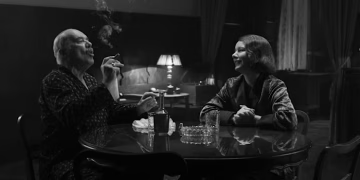
The two women’s class differences are defined through dinners at home where they introduce their lovers to their parents. Adèle’s working class (there’s also a joyous workers street rally) and her parents can’t understand and aren’t expected to: she just tells them Emma is tutoring her in philosophy (which she has sort of done early on). Emma’s parents are from the intelligentsia or arts class and seem to understand the relationship and Emma’s sexuality and be fine with it.
This is a complex film to write about, in its storyline ordinary to the point of complete banality, but in attenuated length of presentation and the graphic sex scenes, extraordinary. It leaves an overall good impression, first because of the adept filming and the talented and 150% committed acting (the sex scenes are specific and real, but that’s only the beginning) and second and equally importantly because of the lively, specific writing. Kechiche has explained repeatedly that everything is precisely written out, though he allows for improvisation too, and likes to establish a scene’s rhythm in the process of shooting it and editing it. Considering how fast-moving the scenes are — for example the two young women’s huge breakup fight, and early on the several rapid-fire dramatic exchanges among Adèle’s classmates outside their lyçée, Kechiche not only writes very well, but directs with amazing fluidness.

But this is a film that polarizes, even as it arouses wild enthusiasm. Yes, it’s remarkable and wonderful, as good as anything Kechiche has done. The two actresses are vibrant and individualized. Their love-making, while sculptural — their entwined bodies are filmed like works of art, is intense, specific and nearly as graphic as any porm movie. They’re not faking. Right after Adèle is first seen by her lyçée classmates hanging out with Emma, who they spot as a “dyke,” they have a yell-fest where she insists she’s not lesbian and one shouts that she’ll be eating pussy any minute, and very shortly she is, on screen. Does all the on screen sex really define the extent of their love, or is it just unnecessary, and distracting? Does it deepen our understanding of their relationship, or is it just another art house merit badge to collect, this time in Lesbian Sex Watching?
Moving beyond the unusually graphic and lengthy sex scenes, does almost every other scene also have to be so prolonged? For example, some time after the affair is over, when Adèle goes to the opening of Emma’s triumphant show — I found her work rather kitsch, by the way — at a top gallery, do we have to follow not only Adèle’s polite conversation with Emma, but her desultory wanderings around the gallery ? Much earlier, when Adèle is installed with Emma and cooks all the dishes for a big party Emma gives, do we have to watch her bring out all the courses? We know from The Secret of the Grain that Kechiche likes to do this kind of thing. But this time his approach is more replete than ever. You may begin to wonder if this “slow cinema” style in the case at hand is a way to make a very ordinary (though beautifully staged and acted) tale seem extraordinary by presenting it in a form that old fashioned viewers will think is an hour or even an hour and a half too long.

The Secret of the Grain also seemed overlong, and Kechiche’s last film Black Venus (NYFF 2010) seemed also excessive in other ways, but this film works on a smaller canvas, and with its many closeups, feels claustrophobic. If this film had been made about a torrid young gay male love affair, would the straight male-dominated audience tolerate it as well? Would they like the age differential (18-27)? Is it fine for a straight male director to shoot unusually long, vivid, graphic, and intense scenes of girl-on-girl lovemaking and have it be considered a socially-aware and politically-correct film? Nevertheless, it’s not so shocking that Kechiche got the top prize at Cannes shared by the two actresses — though Mike D’Angelo, who was at Cannes, and rated many of the films, would have given the top prize to Farhadi’s The Past — not shown at the New York Film Festival, where Blue Is the Warmest Color was screened for this review — and rated four films above Kechiche’s.
Kechiche seems like an artist who’s good at closeups but can’t do long shots. Everything is up close, nothing in perspective. Similarly he lacks the light touch Nouvelle Vague filmmakers like Truffaut had with his Antoine Doinel. Mia Hansen-Løve’s Goodbye, First Love/Un amour de jeunesse (NYFF 2011) is an example of a similar story dealt with more delicately. Mia Hansen-Løve’s young lover, like Adèle, is devastated when her lover goes away, but she provides a fuller sense of her young female protagonist’s living out her vocation, and even supplies her with a more mature and probably more appropriate replacement lover. Kechiche’s approach has wonderful intensity, to say the least, and still does well the student group scenes he did in his early (2003) Games of Love and Chance — and remains interested in the role of the French literary classics can play in working class French kids’ lives — but he lacks the ability to compress, step back, or laugh.

Blue Is the Warmest Color/Le vie d’Adèle – chapitres 1 et 2 debuted in competition at Cannes May 2013, where it also won the FIPRESCI Prize, and it has shown at many other festivals, including the New York Film Festival (11 Oct.), where it was screened for this review.
I recommend Justin Chang’s admirably thorough and knowledgeable description of this film and the director in his Variety review.
Director: Abdellatif Kechiche
Stars: Léa Seydoux, Adèle Exarchopoulos, Salim Kechiouche
Runtime: 179 mins
Country: France, Belgium, Spain
Film Rating: