Dissolving the band
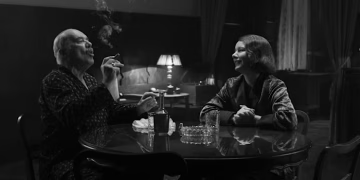
The Fugue Quartet struggles, the blurb says “to stay together in the face of death, competing egos and insuppressible lust.” Opus 131, with its turbulence, roiling passions, and seven instead of four movements to be played full tilt without a break, demands the ultimate in virtuosity and stamina of the four musicians who play it. The film delivers a series of shouting matches, some of which very wisely are conducted at a whisper. It also has a tendency to lecture us on the need for a musician to be free and not too anal; the demands of touring; the advantages of continuity and mature interpretation possible playing in a quartet rather than as a touring soloist; and other such topics. This is a musically savvy and instructive, maybe a bit too instructive, movie, but a rather humorless one. Its brightest moment is a little monologue by Peter (Walken always master of the monologue) in front of a class about two meetings with Pablo Casals. A little scene between Walken and Wallace Shawn, an actor who’s usually fun, and more than a little at home sitting talking in a restaurant, unfortunately is as grim and negative as much of the rest.
This all happens in New York, “debut town,” as Glenn Gould called it, an incestuous world where the musicians who play together sleep together and struggle against irreconcilable differences, and where the perennial answer to “How do you get to Carnegie Hall?” is “Practice, practice, practice.” A Late Quartet was handsomely filmed in Manhattan by Frederick Elmes with snow on the ground, views of brownstone-lined streets and Central Park and warm interiors, including, as if the cultural level were not high enough, a little lecture on some of the great self portraits, Holbein, then Rembrandt, in the Frick Gallery.
Maybe it’s partly out of a misguided desire to compensate for the obvious tameness of its themes, so out of keeping with the needs of blockbuster fans, that this film is sort of like Opus 131, turbulent, roiling, and played at full pitch without a stop. And it’s great stuff in its way. An excellent point is made, if not followed, that the music requires intense emotion, and musicians do well to focus it in concert, not in their private lives, putting aside their personal differences to play as a cohesive whole. But a focus on the professionalism, you can say, wouldn’t make a good movie.
The actors do some playing, and look convincing on their instruments. The film also offers up an almost excessively rich array of doctored photographs to show the principals together in earlier days. Zilberman has obviously assembled a terrific cast. But the screenplay he and his co-writer Seth Grossman produced is overcooked to the point where, for all the handsome interiors and posh acting or perhaps because of those elements, it veers sometimes in the direction of TV schmaltz. The score by Angelo Badalamennti is a hint of this inbred tendency. But there are fine details about bows, bowing, and finering; Zilberman’s previous experience is as a documentarian; and there’s a wealth of classical excerpts, mainly from Haydn, Bach and Strauss, to link scenes. All of this provides satisfaction for serious classical music buffs, nothing more than the whole movement of Beethoven’s Opus 131 as performed by the Brentano String Quartet allowed to play out through the final credits.
For some more coolly devastating depictions of the world of classical music, there are other movies to watch. Take a chastening look, for example, at the short film adapted from Somerset Maugham’s classic story “The Alien Corn” for the classic 1948 British omnibus Quartet. Or skip forward to 1992 for the splendid, melancholy study of discipline and repression on the fringes of the musical world represented by Claude Sautet’s Un Coeur en Hiver, with memorable performances by Daniel Auteul, Emmanuelle Béart, and André Dusollier. Finally for an even more searching examination of classical music’s cruel demands on musical families, watch, if you can find it (it wasn’t released in the US) Denis Dercourt’s 2003 My Children Are Different/Mes enfants ne sont pas comme les autres, with among others Matthieu Amalric, Maurice Garrel and Malik Zidi. Never a moment of schmaltz in any of those three, and the emotion is all the more intense for their surface restraint.
A Late Quartet is out in UK Cinemas on Friday 5th April.
DIRECTOR: YARON ZILBERMAN
WRITER: YARON ZILBERMAN, SETH GROSSMAN
STARS: CHRISTOPHER WALKEN, PHILIP SEYMOUR HOFFMAN, CATHERINE KEENER, MARK IVANIR, IMOGEN POTTS, WALLACE SHAWNY
RUNTIME: 105 MINS APPROX
COUNTRY: USA
Film Rating: