Do you remember the infamous “Dark Universe” photograph? The one with assembled Tom Cruise, Russell Crowe, Javier Bardem, Johnny Depp and Sofia Boutella like one of those Vanity Fair covers? The one that was meant to usher in a new era for horror? The one that signalled the beginning of an MCU-style expanded franchise for Universal Pictures and its catalogue of gothic monsters? You know, the one that started and ended with the 2017 film The Mummy.
Well into that void stepped Blumhouse and writer-director Leigh Whannell. Both were already well-established players in the horror genre. With Whannell responsible for spawning two of the most lucrative and iconic modern franchises in Saw and Insidious. In 2020, he delivered a bold new take on The Invisible Man, which featured Elizabeth Moss excelling as a woman unable to convince people she is being tormented by her former, supposedly deceased, abusive partner.
Jump forward a couple of years and Whannell delivers another riff on a classic monster, rounding up the original Universal creatures like he is collecting Infinity Stones.
Similar to what he did with that movie, here he takes the original concept and source material, and reworks it for the 21st Century to give it a fresh and original spin.
The words “werewolf” or “lycanthrope” are never uttered. There are no full moons or silver bullets.
Instead the metamorphosis is triggered by an infection. The gradual, and grisly, change into beast the result of a rabies-esque infection that was referred to by Native Americans as “The Face of the Wolf”.
The man faced with the possibility of this change is Blake. Fiercely over-protective of his daughter Ginger (named for the Ginger Snaps fans out there no doubt), and becoming increasingly distanced from his wife, he decides to drive the family up to Oregon to pack up his late father’s house when he is declared dead after going missing in the woods.
An extended prologue gives some context for Blake’s personality and behaviour. A misguided hunting trip in the wilderness is evidence that he grew up in the shadow of a grieving military man. A strict, bullish, alpha male who left him with a multitude of internal scars that have yet to heal.
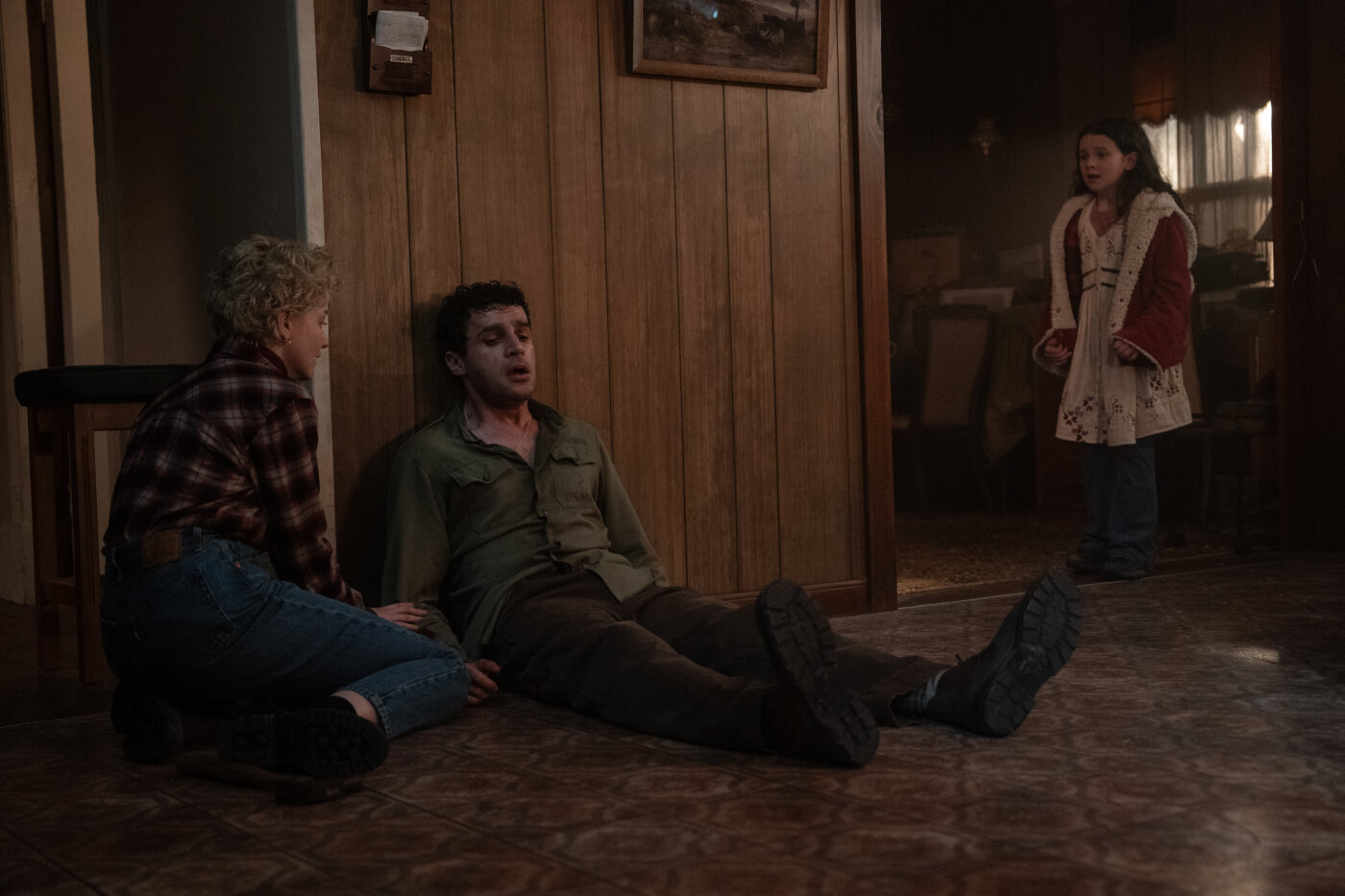
And there is no time for reflection or healing on this trip, because quicker than you can sing Werewolves of London, the family’s removal truck is forced off the road and they are running for their lives in the woods from a mysterious creature stalking them on two legs.
Trapped inside the house, and bleeding from a scratch to his arm, Blake faces two problems. Keeping his family safe from the monster outside… whilst simultaneously struggling to keep the monster inside from awakening.
The horror genre has always held a mirror up to our fears, both at a societal and personal level. On one level, it showcases the fear and pain of watching and losing a family member to a degenerative disease. Also, for the main character, Blake’s has constantly sought to avoid becoming the thing he feared and hated the most – his father. This infection sees him fight against those baser, more animalistic instincts of his nature that have been buried deep down. Now manifesting in violent, gruesome ways.
To paraphrase Seth Brundle in The Fly, a film Whannell has quoted as a major influence, “I am an animal who dreamt he was a man and loved it. But now the dream is over and the animal is awake!”
The decision to primarily use practical effects and make up wherever possible is one of the film’s greatest successes. There is a tangibility to the transformation, and the pain that Blake endures during it. Every tooth that falls out, or bone that bends and snaps, is felt by the audience.
Similar to that film, whilst people want to see this grisly, horrific evolution, what keeps them hooked to the character’s journey is not losing sight of the humanity.
Abbott does an excellent job of maintaining the “Man” within the “Wolf Man”. Convincing us of his torment through the physicality of his performance. his pained, soulful eyes are never lost within the prosthetics. Plus the connection he has with his daughter (Matilda Firth) keeps him tethered for as long as possible.
By foregoing the mythology, and a tight runtime of 103 minutes, the film focuses on delivering a tense, atmospheric blend of family drama, home invasion thriller (albeit with some questionable decision making by Julia Garner’s character) and icky body horror. Indeed, one particular method of escape appears to be a playful nod to the writer-director’s very first film… no *spoilers*
The result is a lean, mean, nasty thrill ride that will leave fans hungry (like the wolf) for more from Whannell’s personal “dark universe”.
Wolf Man is in cinemas now
Rating: 

Director: Leigh Whannell
Stars: Christopher Abbott, Julia Garner, Matilda Firth
Runtime: 103 minutes
Country: USA