It gives me no pleasure to write this: Duchess is appalling. At best it’s derivative, dull, and messy. At worst it’s depraved, ugly, and crude. If you’d told me it was created by crass frat boys rather than Neil Marshall, a filmmaker with a proven track record, I’d have believed you.
Marshall, who serves as director and co-writer of Duchess, has some impressive credits. His debut feature, Dog Soldiers, is a great blending of humour and horror. The Descent has a terrific concept, one that taps into the dread of claustrophobia marvellously. He has even directed one of the best episodes of Game of Thrones – Blackwater. The drop in quality between them and Duchess is staggering. Rather than a slick or exciting thriller, Duchess feels like little more than an excuse to get lead actor Charlotte Kirk, who happens to be Marshall’s fiancé, into scanty clothing.
Our protagonist is small-time English crook Scarlett Monaghan (Kirk). Her small fish crimes get an upgrade when she falls for the handsome Rob (Phillip Winchester), who is in the business of diamond smuggling. This makes him extremely wealthy, and a romance, primarily consisting of badly lit sex scenes, blossoms between the two. But when a business deal goes wrong, Rob is murdered and Scarlett is left for dead. Now she seeks retribution and, through Rob’s money and connections, has all the tools she needs to track down those that wronged her. It’s a solid enough hook in fairness. Too bad it takes over an hour to get to this point.
The press release for Duchess describes it as a fresh take on a genre we all love – the crime thriller – popularised by filmmakers like Martin Scorsese and Quentin Tarantino. The freshness it alludes to is in placing a woman centrestage of this often male dominated genre. Kirk serving as a co-writer as well as the star certainly lends credence to these aims. Yet, instead of an empowering feminist story, the film proves revoltingly chauvinistic. How else to explain the first half’s endless scenes of Scarlett in bikinis and tight dresses, usually clinging to the arm of her diamond smuggling lover, adoring her role as the boss man’s eye candy. Sure, she’s learning to box to protect herself, but, until the plot kills Rob off, she still relies on him to save her when needed. Her eventual drive for retaliation is motivated entirely by Rob’s death – because nothing says girl power like obsessing over a man.
Its two stories – an origin tale and a revenge tale – are badly woven together, with Kirk’s supposedly badass anti-heroine being far too passive in the first half to be considered “empowering”. The romance between her and Rob takes up this first half, in which she is all but relegated to a side character so the film can bask in Rob’s prominent masculinity. Cars, wealth, muscles, sexual prowess – all that’s missing is him referring to himself as an “alpha”. Even when Scarlett begins her revenge spree, so much time is dedicated to her grief over Rob that her own agency is robbed. She’s a nothingburger of a character; a stale imitation of an action archetype. Kirk’s horrendous performance, which consists almost entirely of scowls and f-bombs, doesn’t make the character any easier to engage with.
In trying to emulate popular gangster films, Duchess utilises a lot of techniques that are perhaps most synonymous with Guy Ritchie pictures – voiceover narration, rapid editing, excessive violence, grimy cinematography, and dialogue so foul-mouthed it would make Samuel L. Jackson bring out the mouth-washing soap. There’s nothing wrong with taking influence from other filmmakers – even Ritchie’s style was heavily influenced by films like Pulp Fiction. Yet Duchess possesses none of the charm, idiosyncrasy, or intrigue that makes even weaker Ritchie pictures like King Arthur: Legend of the Sword somewhat memorable.
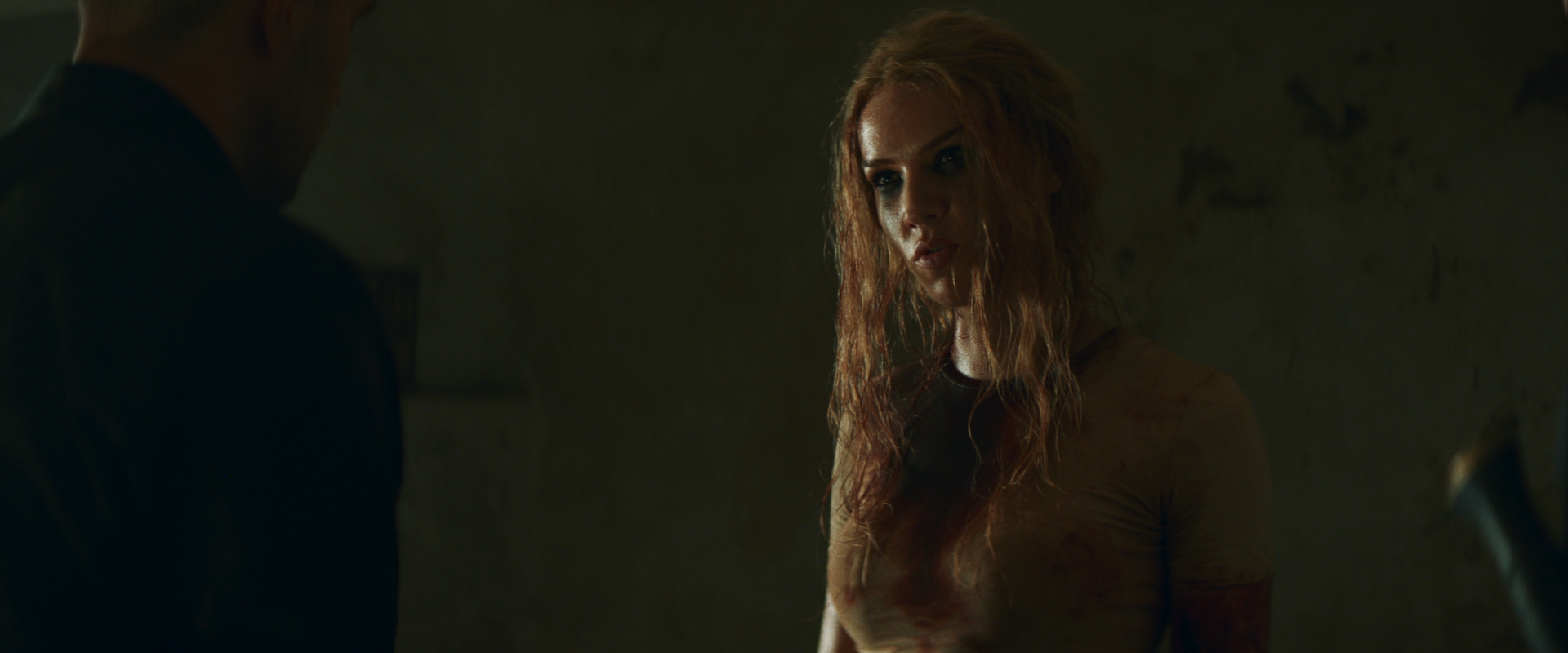
Candidly, the filmmaking is shambolic. The quickfire editing makes it difficult to discern what’s happening during the action scenes, while the murky lighting and colour palette makes the spectacle visually ugly, worsening the fakery of the CGI blood, and blatant uses of ADR. Many of the setpieces, such as an underground casino, are overused tropes of the genre, but others are straight up ridiculous – the most egregious of which being a tiger pit, complete with stock footage of a tiger that was clearly filmed in a separate location. It would’ve been a good parody of the genre if it wasn’t taking itself so seriously.
Bizarrely, Duchess is quite sensitive about its own usage of violence. In between the unconvincing choreography of the fighting, it regularly cuts away from extreme instances of blood spillage. The most notable instance of this is a scene in which the character of Charlie (Stephanie Beacham) slits the throat of one of her henchmen, where we only see specs of CGI blood at the bottom of the screen. Even graphic moments of torture in the third act are defined by theatrical overacting rather than in the extremity of the content. Despite attempts at rambunctious filmmaking, it’s awkwardly toothless instead. Say what you will about Ritchie or Tarantino – at least their films embrace their violent natures.
The film’s worst symptom is an immature, underdeveloped script – one that seems to think its cliches are groundbreaking rather than tired. The story is convoluted, the filmmaking is sloppy, and the characterisation is one note, making the whole thing feel less like female empowerment and more like a grating male fantasy – even with Kirk as a co-writer. The film tries to compensate for the lack of emotional involvement by having Scarlett recite odious voiceover narrations that are little more than exposition or monologues on love or power. Much of the writing is motivated not by the conflict or character choices, but by how potty-mouthed it can be. Dialogue witticisms include, “I have to pee, then you can fuck me again”, “One thing I can’t abide by is cuntery”, and “Just like cocks, power comes in all shapes and sizes”. Embarrassing doesn’t even begin to describe it.
Herculean stubbornness was the one thing that kept me from walking out of Duchess. Obnoxious in style and scattershot in narrative, it’s a sleazy geek show masquerading as feminism, its themes on violence and the dangerous draw of revenge completely undermined by the juvenile writing and filmmaking. Marshall is no stranger to disowning his movies, (rightfully) calling his 2019 Hellboy film unworthy of his canon. When it comes to Duchess, Marshall should consider taking inspiration from George Lucas, who once said of the infamous Star Wars Holiday Special, “if I had time and a sledgehammer, I would track down every copy… and smash it”.
Rating: 

Director: Neil Marshall
Writers: Neil Marshall, Charlotte Kirk and Simon Farr
Stars: Charlotte Kirk, Phillip Winchester, Sean Pertwee, Stephanie Beacham
Runtime: 114 minutes
Country: UK