With the release of the Coen’s modern western epic True Grit, it’s perhaps high time to take a look back at the genre’s long history and pick out some of its true classics.
1. The Good, The Bad and The Ugly (1966)

The third and final part of Sergio Leone’s and Clint Eastwood’s Dollars Trilogy is easily the most gripping of the three. Set at the height of the American Civil War, Eastwood’s Blondie, Lee Van Cleef’s Angel Eyes and Eli Wallach’s Tuco, each try to outwit and double-cross the other on their way to obtaining a buried hoard of gold. The standard Spaghetti western traits are all there, the simmering heat, the sweat dripping banditos, the remarkably southern European looking Americans, but with an iconic performance from Eastwood and an unforgettable Ennio Morricone score, this 70’s classic stands head and shoulders above the rest.
2. The Searchers (1956)

A bigoted racist scours the West to find his niece who has been abducted by Injuns with the intention of murdering her so that she is spared the hell of living as a Native American. John Wayne’s Ethan Edwards may not sound like a typical Western hero, but then this bonafide classic is not a typical Western. Wayne arguably gives a career best performance as the conflicted wanderer whose dedicated quest is driven in equal parts by devotion and sheer hatred. It’s a complex and dark movie set against the breathtaking backdrop of Monument Valley. John Ford’s legendary vistas have never looked better.
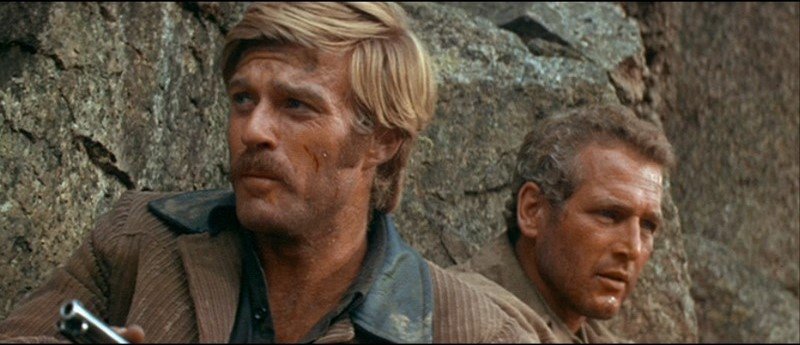
3. Butch Cassidy and the Sundance Kid (1968)

Newman and Redford banter their way across America, Bolivia and beyond in one of the most effortlessly entertaining films of all time. While it may not match other westerns for gritty authenticity or even gun slinging brutality, it trumps all of them in terms of its simple yet winning story. The two lovable outlaws rob faceless banks and go on the run across the length and breadth of America. On their way to an inevitable comeuppance, the two friends fight to remain one step ahead of the law and answer that eternal question….”who are those guys?”
4. High Plains Drifter (1973)

Clint Eastwood once again takes up the role of the man with no name, this time riding into the town of Lago, seemingly to help the petrified towns people who live in fear of attack by a violent outlaw gang. The town of Lago holds a horrific secret however, and Clint’s mysterious stranger appears to be out to teach them a brutal lesson of his own. Eastwood also directs this gritty Western, and the supernatural twist that arrives at the film’s climax is a unique touch that rounds the movie off in style.
5. Unforgiven (1992)

In the early 90’s Eastwood offered his own reappraisal of Western folklore with the starkly violent Unforgiven. Here, Eastwood drew a line under his own career in the genre by looking at what happens to the ageing cowboy once the West became slowly civilized. Eastwood’s William Munny was once a cold blooded and feared killer, and despite his decision to settle down and raise a family, the lure of one final pay day for taking out a couple of whore-beating crooks proves too much to resist.
6. High Noon (1952)
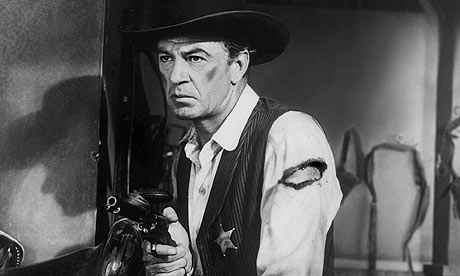
John Wayne hated it, claiming it was “the most un-American thing I’ve ever seen in my whole life.” The Duke, known for his conservative views, took great objection to Director Hans Zimmerman’s tense Western that was a thinly veiled critical allegory for the McCarthy era’s blacklisting of supposed Commie sympathisers. Wayne was a big proponent of the blacklisting and ultimately, in part thanks to Wayne’s political clout, High Noon’s scriptwriter Carl Foreman was himself run out of town by the House Un-American committee. The film remains a classic however and Cooper is never better than the reluctant sheriff doing his duty against the odds.
7. The Wild Bunch (1969)

Sam Peckinpah’s overblown and violent homage to the end of the cowboy era depicted the senseless violence of the old west in all its bloody glory. William Holden and Ernest Borgnine are perfectly cast as the world weary old gunslingers, now residing in slowly civilising society. The film’s climatic battle took 12 days to film and used an impressive 10,000 squibs; needless to say, we’re talking a body count on a Hotshots Part Deux type scale. Far more than just a gory bloodbath however, The Wild Bunch is a fitting ode to the end of an era, not just that of the old West on screen, but also in Hollywood itself, where the classic mythologized view of the old West was slowly being replaced by brutal realism.
8. The Man who shot Liberty Valance (1962)

John Ford may be synonymous with the sweeping Western epic, but in 1962 he released this all together more low-key Western starring both John Wayne and James Stewart. The two stalwarts play the contrasting yin and yang of the movie, Wayne’s Tom Doniphon the rough, tough gunman who plays by his own rules, and Stewart’s Ransom Stoddard, the civilised do-gooder seeking to bring law and order to the brutal West. This is Ford not offering big spectacle and bravura gun fights, it’s an intriguing analysis of the the contrast between truth and legend in the history of the the Old West.
9. Rio Bravo (1959)

John Wayne and a ragtag band of allies, including a precious young gunslinger, a crippled old man and his deputy, a recovering alcoholic played with no great stretch by Dean Martin, guard a dangerous prisoner whose gang has vowed to bust him out. Rio Bravo was made by Wayne and director Howard Hawks in response to High Noon and once again the film revolves around the threat of an outlaw gang riding into a small town and endangering the townsfolk. While Cooper was left on his own by those he called friends, here Wayne can count on his closest allies and ultimately the townsfolk themselves to help him out. It may be slightly more conventional as stories go, but it’s every bit as entertaining.
10. Once upon a time in the west (1968)

Leone’s Western masterpiece sacrifices the upbeat tempo of the original Dollars trilogy and instead opts for a much more serious and threatening tone. Henry Fonda is superb, playing against type as the ruthless killer Frank. He and his gang lay their ‘baddy’ cards on the table early on as they kill an innocent landowner, (named McBain… insert your own Simpsons joke here) and his three children over a land dispute. Soon McBain’s new bride arrives at the farmhouse and with the help of Charles Bronson’s iconic gunfighter; ‘Harmonica’ sets out to get revenge on Frank and his gang amidst a series of doubles crosses and shoot outs. The legendary opening scene, where three no-good bandits await Harmonica’s arrival by train, is a master class in building tension.