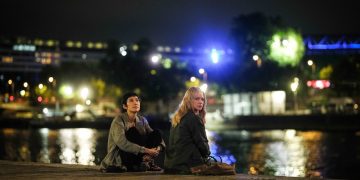
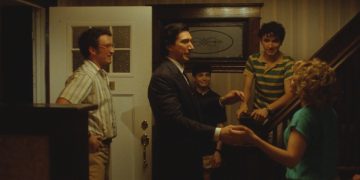
Premiering at Cannes 2024, An Unfinished Film is a docu-fiction feature by Chinese filmmaker Lou Ye that won Best Narrative Feature and Best Director at the 2024 Golden Horse Awards, which honour standout features in Asian-language cinema.
The film opens in 2019, when director Xiaorui (Mao Xiaorui) and his team are booting up an old computer to recover one of his earlier projects. As his colleagues excitedly recover old footage and sound files, he meets with his lead actor, Jiang Cheng (Qin Hao), with a clear goal in mind – to finish the film he started ten years prior. But as Xiaorui’s fictional production stalls because of COVID, Le’s documentary comes to life as he brazenly delivers a personal insight to Wuhan at the start of the pandemic.
The docufiction-style of Lou’s film blurs the line between fact and fiction, which causes initial confusion as to the path of the film. Audiences initially see Xiaorui’s desire of finishing a labour of love despite a ten-year gap and the risk of his LGBQT romance being censored – serving as a nod to Lou’s features about sexuality and politics facing fire from China. As soon as Xiaorui settles into production, COVID hits and the crew’s hotel base becomes a horror show with PPE-wearing authorities forcing people back into their rooms. This sudden turn of events evokes a visual whirlwind of disarray but Lou’s careful direction turns An Unfinished Film into a project that is not just about a passion for filmmaking – it becomes a history lesson as what happened in Wuhan at the start of COVID.
Through his screenplay, Lou accentuates the mental turmoil of being under quarantine in a growing pandemic. There is an unsettling anxiety and urgency during the events leading up to this point, ranging from a fear of infection to combativeness when people try to leave – especially when everyone is trying to go home for Chinese New Year. But as soon as it reaches this high, the pacing dwindles as soon as quarantine hits so the characters are left alone and palpable tension and fear of the situation, causing it to mull over an unforeseeable future.
Most of the film’s frustration emanates from Jiang’s POV, as he is separated from his newborn daughter and struggling wife. Thanks to Hao’s fraught performance, he conveys his character’s exasperation and isolation in person or through Facetime calls, muddling through what is ultimately a personal journey rarely seen in cinema: what happens when one is suddenly caught in a pandemic. But the film’s discomfort is further exacerbated through Lou’s use of footage that has either banned or blocked in China, showing audiences that there is an engaging story to tell at the risk of being silenced.
In addition, An Unfinished Film brings a rare insight as to how COVID impacted the filmmaking industry. Production schedules were either stalled or cancelled, as were release dates of highly anticipated films. Even though it has been around two years since the “end” of COVID, the effects it has had on the world still linger. Even Jiang wistfully comments that the pandemic is “a once-in-a-lifetime” occurrence, reiterating that his struggle is a journey to be remembered. Even a group meeting, despite being separated by walls and corridors, to dance, drink and celebrate Chinese New Year – becomes a rare yet memorable moment of happiness and optimism in a time of uncertainty. Through Lou’s eyes, there is a perseverance and pride that comes from a different place to the film’s opening scene. When An Unfinished Film reaches its contemplative end, it may not have been the film that was to be finished but it became one that needed to be told.
An Unfinished Film incorporates a daring approach on a subject that audiences may not feel ready to relive, yet Lou breaks the boundaries to deliver a fascinating feature that was born from fiction but built by real life. The result is artistic, divisive but nonetheless necessary.
Rating: 

Director: Lou Ye, Yingli Ma (co-screenwriter)
Stars: Qin Hao, Xiaorui Mao, Xi Qi, Xuan Huang
Runtime: 107 minutes
Country: China