Set adrift by Hollywood for many years, Brendan Fraser lands his very own white whale with the performance of a lifetime in Darren Aronofosky’s The Whale.
When the film begins, Charlie, an online English tutor, is hidden behind an inactive webcam. Ashamed of his own appearance, he interacts with people through walls he has erected. Both physical, digital and emotional. He has retreated from the world following the death of his partner. The loss left a huge void in his life. One that he has filled with guilt, shame and food.
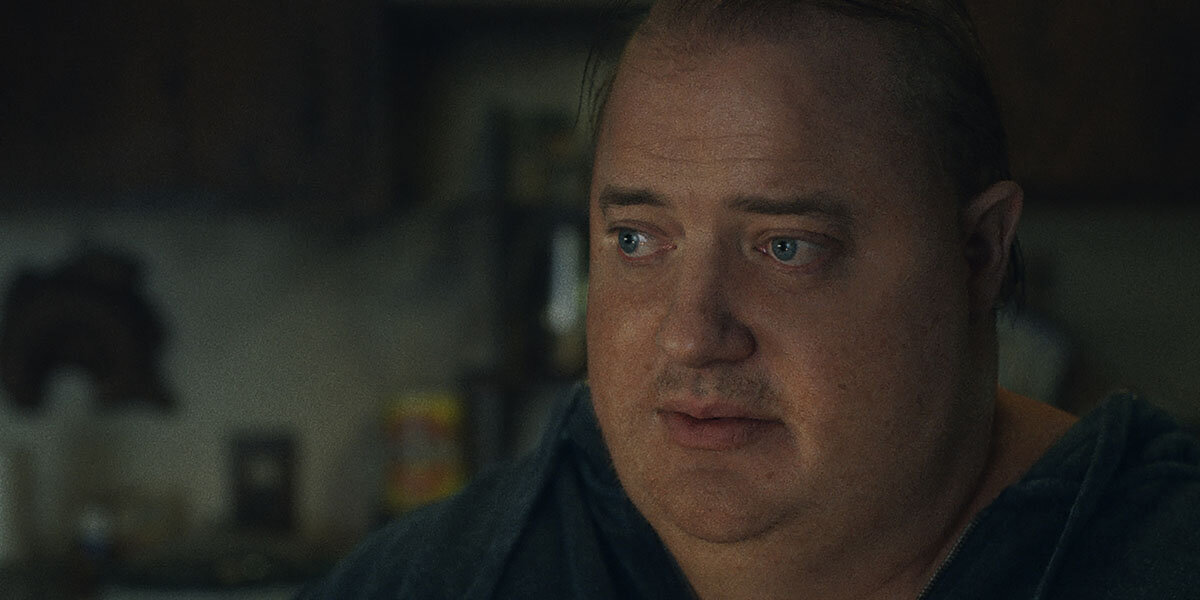
Inhabiting 300 pounds of make up and full body prosthetics, Brendan Fraser disappears into the body suit and the role and only Charlie remains. Audiences will see him and feel many things; sadness, disgust but never pity. That is because he is infused with some of Fraser’s own best qualities. An inherent sense of positivity and optimism, in spite of everything that everything life has thrown at him. It is simply unfathomable to even consider Fraser not receiving a Best Actor nomination for this performance.
The titular whale refers not to an unkind slur against the morbidly obese central character but the whale from Moby Dick. It relates to an essay that Charlie is fond of reading. The author of the essay is unclear but as he is a teacher, it is presumably from one of his students. Possibly his boyfriend who he met while teaching him, ultimately leaving his wife and daughter for.
The whale is the target of Captain Ahab’s doomed quest. An obsessive quest, to the point of self-destruction, is at the heart of many of Darren Aronofsky’s protagonists. In Black Swan, Nina sought the perfect performance. For Randy “The Ram” in The Wrestler, it was not a championship title but the cheers of the audience.
For Charlie, ultimately all he yearns for is the acceptance and love of his daughter.
Sadie Sink has received a lot of praise for her work in the recent season of Stranger Things. Here, in the role of Ellie, she proves that she is the real deal and a bonefide superstar in the making. She lights up Charlie’s murky apartment whenever she is on-screen and leaves a void when she is not. The audience misses her just as much as her father. She flicks effortlessly between sullen and hostile, directing her rage at her absent father. In other words, the perfect teenager performance. The way she verbally attacks him, she feels like a vicious intruder who has broken into his fortress of solitude. The use of 4:3 aspect ratio increases the sense of being trapped within the frame just as Charlie is confined to his apartment.
The central father-daughter relationship is the film’s heart however there are strong performances across the board. Hong Chau as his friend and carer Liz, Ty Simpkins as Thomas, a church missionary who sees Charlie as someone to save, and Samantha Morton as his ex-wife Mary. It is a small but exceptional ensemble.
The way these characters come and go through the film feels rather theatrical. In that they are simply “exiting stage left”. So it is no surprise to learn this is adapted from the stage by the playwright himself, Samuel D. Hunter. It is a testament to the screenplay and the performances that the film transcends these four walls to become something truly astonishing. Powered by Rob Simenson’s fantastic score, the final scene builds to an emotional crescendo that breaks down the fourth wall and audience tears to flow like raging rapids.
“See how elastic our prejudices grow when once love comes to bend them.” This quote from Moby Dick perfectly encapsulates The Whale. A film that forces us to reevaluate our preconceptions around those different from us. A task made infinitely easier by Fraser’s hugely empathetic performance.
The Whale premiered at the Venice Film Festival and is in US cinemas from December 9
Rating: 
Director: Darren Aronofsky
Stars: Brendan Fraser, Sadie Sink, Samantha Morton, Hong Chau
Runtime: 117 minutes
Country: USA