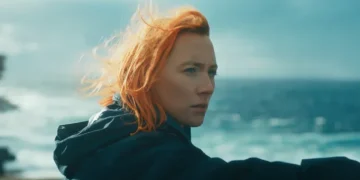
With Blooded being released in cinemas today and hitting DVD not long afterward, I was pleased to be able to both review the movie (see the review here) and interview its director, Edward Boase, over the phone today. Thankfully, after having spent some time on Mull, Mr. Boase had no problem with my Scottish brogue and here is what he had to say about his new film.*
Flickfeast: Blooded featured some great aerial photography and beautiful landscape jobs, how did you manage to get so lucky with the notoriously fickle Scottish weather or was there always a plan b on standby?
Edward Boase: Lots of tents, lots of waterproofs, tea and coffee and bacon sandwiches available. The weather was certainly a factor at times but even when it did rain it was rarely for more than half an hour at a time. We scheduled around things as best we could, ready to stop/start at short notice, and during the two full days of rain that we had that’s when we tried to get more of the indoor shots, etc.
FF: The movie features a lot of time spent with the cast being, seemingly, very cold outdoors. Most of the cast even had to spend quite some time outside in nothing but their underwear. Did this harbour any resentment towards yourself or did you compensate by making sure the teas and coffees were always to hand?
EB: It was definitely tough for the actors. When you’re stuck there in the cold and the wet it’s not just acting by then, it’s real. 1 week prior to the start of shooting we had a couple of army people come along to run a boot camp type of thing for the actors, which basically consisted of them crawling around, getting muddy and preparing themselves endurance-wise. One actor made the mistake of drinking some bogwater and ended up in hospital for two days.
FF: The film has a very authentic feel. Did this come easily or did you look over various examples of the talking head/reconstruction programmes that you were aiming to emulate?
EB: The main inspiration for the look and feel of the movie was Touching The Void. It tells a dramatic story in the same way with the talking heads and the reconstruction. The style was really based on that, and also proved to be a big financial plus with the simpler, “studio-set” moments. It ended up being both a blessing and a curse as we’ve ended up with something that many think is too real. It was never intended to be put out there as a hoax, I wanted to make a thriller in a very different style.
FF: All of the actors were excellent and most of them have background in television, did you feel that was an advantage given the format that the movie was recreating or did you simply set out to pick people looking similiar (between the talking heads and the actors in the reconstruction) who would deal with the material?
EB:We cast and shot the reconstruction material first with the best actors we found. A big consideration, as well as the acting skills of those involved, concerned how these different personalities would work while stuck on Mull for a month. It was 8 months later that we had to cast the actors in the “real” roles. We were initially trying to find people physically similiar to those who had acted in the reconstruction segment but our great casting director, Gillian Hawser, advised us just to go with the best actors and not worry about the physical aspect. Some of our actors look quite similiar, some don’t.
FF: With the different shooting styles (the rather static “studio” material, the cinematic reconstruction scenes and the hand-held videocamera footage) was it difficult to remember he different restrictions and stay within set parameters or did the equipment help to dictate the style anyway?
EB: The Real Animal League footage was shot on a hi-def camera so our director of photography, Kate Reid, was frustrated about us deliberatle going for a low-tech, unprofessional look. The additional work was having to go back to Mull with the actors playing the “real” people and recreating the events to capture that footage that would make the viral video. My main concern was that the difference between the reconstruction footage and that filmed by the RAL would not be noticeable but, thankfully, when seeing the movie in the cinema the difference was clear.
FF: There is a pleasing non-judgmental overview of the pros and cons of hunting, were you ever tempted to skew the movie in favour of one view or the other?
EB: No, never. Despite the fact that the movie does look at hunting it’s not actually about that subject. It’s more about extremism in its various forms. Lucas Bell is extreme in the way that he will not give up something he believes passionately in while the animal rights activists are extreme in their planned actions. I wasn’t interested in making a movie that would weigh in on either side of the hunting debate.
FF: How worried were you about offending people with the deer-gutting scene? I know people who turn away from anything like that within a film and yet with Blooded one of the points raised is accepting where the lovely meal on your table comes from.
EB: I was never worried about offending anyone and didn’t intend to. The deer was already dead, we’d purchased it from a local gamekeeper, and that scene really summed up a comment on our attitude to food nowadays. Everyone is happy to purchase meat shrink-wrapped from their local supermarket but that meat is put there because an animal has been killed and prepared. We actually showed that clip in some schools, to 6th formers who’d seen a lot stronger stuff than that, and there was a very strong reaction to it, which provokes thought and discussion about how we live our lives today and where things come from.
FF: The final question has to be, almost inevitably, would you yourself be able to take a shot and kill something to feed yourself in that type of environment?
EB: Well, as I speak about on the DVD commentary, when I was about 12 years old I shot a bird with an air rifle and killed it. I think every young boy goes through that phase of wanting to hurt something and see what happens, it’s almost like a rite of passage. I felt guilty, it was unpleasant, it was very difficult. I’m not sure what my answer would be, I’d certainly find it very difficult and that’s why the movie point out the hypocrisy of people who may stand against things and then not question anything that comes to them cleaned and prepackaged.
Blooded is released in cinemas 1st April 2011 and hits shiny disc form on 4th April 2011. It is also available via download & on demand April 1st, further details available from the official site at the following:
ONLINE – http://www.bloodedmovie.com/online.html (LoveFilm, iTunes, BlinkBox)
ON TV – http://www.bloodedmovie.com/ontv.html (FilmFlex, Playstation, Sky Box Office)
Buy now at Amazon:
http://www.amazon.co.uk/Blooded-DVD/dp/B004EEMC54/ref=sr_1_1?s=dvd&ie=UTF8&qid=1296743368&sr=1-1
Buy now at HMV:
http://hmv.com/hmvweb/displayProductDetails.do?ctx=280;0;-1;-1;-1&sku=843588
*This interview was fully written out after our phone conversation, from my shorthand notes that sometimes start to resemble The Da Vinci Code, and I must just end by thanking Edward Boase once again for his time, for being such a good interviewee and for putting his points across so well. I hope to see more from this man in the near future.